Which Random Video Chat Platform Fits Your Privacy Priorities?
There is no single “best Omegle alternative” for every adult. Chatroulette, OmeTV and Emerald Chat all offer random conversations, but they organise matching, moderation and user controls in noticeably different ways.
This comparison looks beyond bright interfaces and live-user counters. It focuses on the practical questions that affect a real session: how much control you have before connecting, how each service describes reporting and age rules, what privacy trade-offs remain and which platform fits a particular priority.
Platform features, availability and policies can change by country, account type and date. Treat the comparison as a decision framework, not a guarantee that any random-chat service is risk-free.
A better match is not automatically a safer match. The useful comparison is the one that helps you leave quickly, report clearly and share less.
What this Omegle-style platform comparison measures
The three services are not identical products. Chatroulette is associated with a simple random flow, OmeTV emphasises quick global matching and text communication, while Emerald Chat presents more structure through interests, karma and multiple chat modes.
For this article, “safety” means practical control rather than a promise of perfect protection. The key signals are visible reporting, clear rules, meaningful age boundaries, privacy information, match controls and the ability to end a conversation without pressure.
Before trying any new service, use the platform reputation guide to check the domain, reporting route and privacy documentation independently. The clone safety guide adds a second check for copied branding and missing operator information.
Quick comparison: Chatroulette, OmeTV and Emerald Chat
| Platform | Best fit | Structure and controls | Main privacy question |
|---|---|---|---|
| Chatroulette | Adults who want a direct, low-friction random flow. | Simple random matching, Next-style exit and in-session reporting. | How comfortable are you with limited pre-match context? |
| OmeTV | Adults who value fast global matching and text support. | Rules, reporting, text chat and language/translation-oriented features. | What does the service collect and how reliable is age assurance in your region? |
| Emerald Chat | Adults who want interests and reputation signals before or during a chat. | Interest matching, karma, text/video/group options and reporting tools. | How much profile or account information are you comfortable providing? |
This table is a starting point. A visible control can improve a decision without guaranteeing that every interaction will be comfortable.
Chatroulette: the simplest random-chat experience
Chatroulette is the closest of the three to the classic random-video-chat idea: open a session, meet a stranger and move on when the conversation is not right. That simplicity can be useful for adults who do not want to complete a long profile before trying a service.
The trade-off is context. The less you know before connecting, the more important it becomes to keep your camera background neutral, avoid personal details and use the exit or report control early. A minimalist interface can reduce friction, but it can also leave you doing more of the safety work yourself.
Chatroulette’s official safety and reporting standards describe age assurance, automated checks, human moderation and a visible report route. Those are useful signals to look for, but they do not remove the ordinary risks of live interaction with strangers.

OmeTV: fast matching with more visible rules
OmeTV is designed around quick random connections and includes text communication alongside video. Its official rules describe prohibited behaviour, reporting and adult-only access. That creates a clearer policy layer than a service that leaves users guessing where to report a problem.
The independent eSafety Commissioner’s OmeTV guide notes that the platform is intended for adults, supports random video chat and offers reporting through in-app functions. It also points out that age assurance and enforcement can be important limitations, and that availability may differ by country.
That distinction matters. A published rule tells you what the service does not allow; it does not prove that every live session is filtered perfectly. Treat translation, country preferences and quick matching as convenience features, not as identity verification.

Emerald Chat: more structure through interests and karma
Emerald Chat takes a more structured approach. Its own explanation of whether the service is legitimate highlights interest matching, a karma system, text and video modes, group chat and a combination of AI and human moderation.
Those features can make conversations feel less arbitrary. Interests offer a reason to start talking, while a reputation signal can give users another piece of context. Neither feature should be treated as proof that a stranger is trustworthy. A positive score or shared interest does not confirm someone’s identity, intentions or age.
The official Emerald Chat overview also acknowledges that users remain responsible for what they share. That is the right way to read any platform’s safety claim: moderation can act on reports and policy violations, but it cannot undo a phone number, location or private detail that a user has already revealed.

Privacy differences that matter before you turn on the camera
Ask the same questions of every platform instead of accepting its marketing language:
- Can you start with text or limited permissions before enabling video?
- What account, device and connection data does the service collect?
- Are chats stored, reviewed for moderation or linked to an account?
- Can another participant record the session even if the platform says it does not?
- Can you block, report and leave without continuing the conversation?
The privacy data guide explains why IP addresses, device details, session metadata and visible background information should all be considered. A platform’s privacy policy is more useful when you read the retention and sharing sections, not only the opening promise.
For site-side data practices, you can also review the OmegleLeaked Privacy Policy. It does not replace reading the policy of the third-party platform you actually choose.
Moderation and reporting: what to look for in practice
A strong comparison does not ask which platform claims to be safest. It asks what happens when a user crosses a boundary.
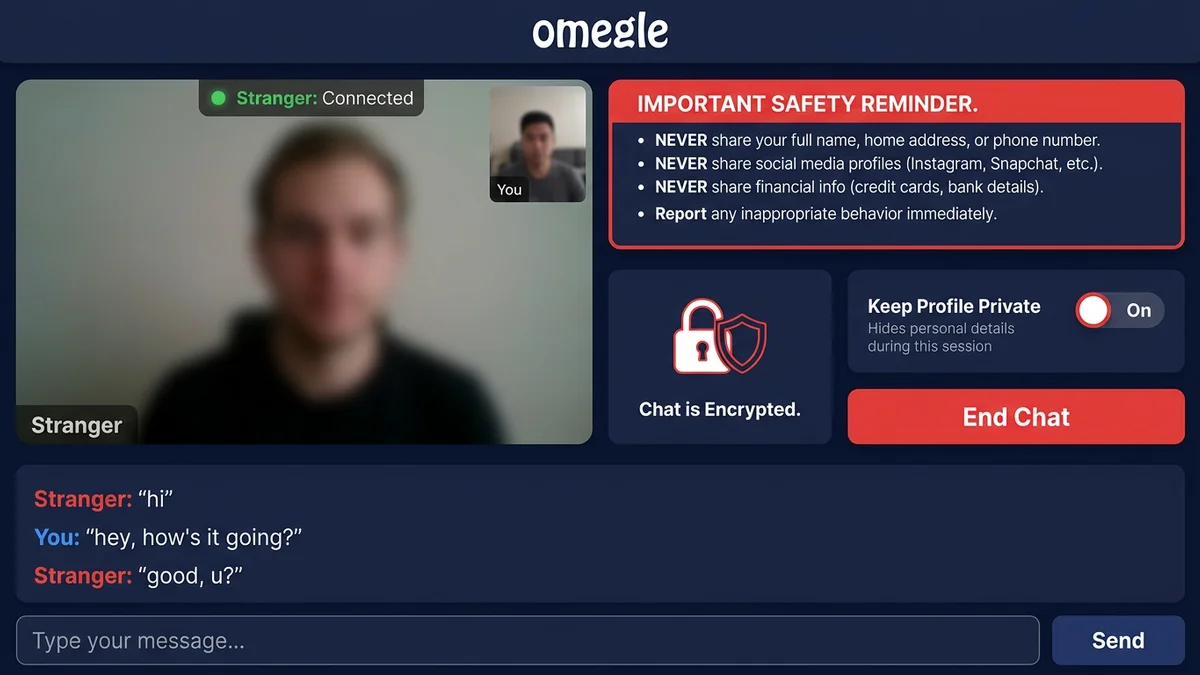
- Find the report button before you need it. Check whether it is visible inside a live session and whether you can report without starting a public argument.
- Check the exit path. The Next, Leave or End button should be obvious and should not require an explanation.
- Read the rules. Look for clear language about harassment, impersonation, threats, unwanted recording, spam and privacy violations.
- Check appeals and support. A platform should explain where users can ask about a ban or safety decision.
- Assume enforcement is imperfect. Automated moderation can miss context, while user reports can be incomplete or mistaken.
Internet Matters’ OmeTV safety guide is written for parents and carers, but its practical warnings about random video, recording and privacy exposure are also relevant to adult users evaluating any stranger-chat platform.
Which platform fits your privacy priority?
| Your priority | Starting point | Why | What to verify yourself |
|---|---|---|---|
| Fastest low-friction random chat | Chatroulette | Simple entry and a direct random flow. | Current age assurance, report visibility and data handling. |
| Language or global conversation | OmeTV | Text and translation-oriented features can reduce friction. | Regional availability, age assurance and enforcement quality. |
| More context before connecting | Emerald Chat | Interests and karma add structure to matching. | What the signals mean and what account data is required. |
| Most control over your own risk | Any, with text-first use | Starting without camera access limits early exposure. | Permissions, recording risk and how quickly you can leave. |
Do not choose solely because a platform has the most attractive interface or the largest online counter. A smaller set of controls that you can actually find may be more useful than a long feature list.
If you want a single-platform case study rather than a three-way comparison, the OpenTalk review shows how features, moderation and privacy questions can be assessed in one service.

Common mistakes when switching from Omegle-style chat
- Assuming that a familiar interface means the operator has the same privacy practices.
- Turning on the camera before checking the background and permissions.
- Sharing a phone number or social handle because the conversation feels friendly.
- Relying on a filter as if it were identity or age verification.
- Arguing with a stranger instead of using Next, block or report.
- Believing that a platform’s “anonymous” label prevents screenshots or recordings.
- Using a random link sent in chat instead of verifying the domain independently.
FAQ: choosing an Omegle alternative
Which is safest: Chatroulette, OmeTV or Emerald Chat?
There is no universal winner. Emerald Chat offers more structure, OmeTV emphasises fast global matching and Chatroulette keeps the flow simple. Compare current rules, reporting and privacy controls for your country.
Is Emerald Chat better than Chatroulette for matching?
It may suit users who want interests and reputation signals. Chatroulette may suit users who prefer a quicker, more minimal random flow. Neither signal proves that a stranger is trustworthy.
Does OmeTV translation make the chat private?
No. Translation can make communication easier, but it does not change what the platform or another participant may process, record or learn from the session.
Should I use a gender or country filter?
Only if you understand what the filter does and what it does not do. A preference can change matching, but it does not verify identity, age, intentions or consent.
What should I do if a platform feels unsafe?
End the session, block or report the account, record only the information needed for a report and review your permissions. Do not continue the conversation to collect proof.