What Ethical Sharing Looks Like for Adult Creators
Adult content online is not automatically public content. A creator may choose to make something available to paying members, share it privately with one person or publish a limited preview without giving permission for every other use.
The same principle applies to live video chat. Agreeing to appear on camera does not automatically mean agreeing to be recorded, reposted, sold, edited, indexed or shown to a different audience. Consent is specific to the action, the people involved and the context.
This guide is for adults and focuses on digital consent, privacy and creator rights. It does not provide access to intimate material or encourage redistribution. When the facts are disputed, local legal advice is more reliable than a general online checklist.
Seeing content is not the same as owning the right to copy, repost or commercialise it.
What digital consent means for adult content online
Digital consent is an active agreement about what happens through a screen. It can involve creating a photo, joining a video call, appearing in a livestream, sending a file, allowing a recording or agreeing to a specific audience.
Consent should be freely given, informed, specific and changeable. A person should be able to say yes or no without pressure, and the other person should respect the answer without punishment, guilt or repeated demands.
The National Sexual Violence Resource Center’s guidance on digital consent and everyday online boundaries emphasises asking before posting, reposting or sharing something personal. That is a useful rule for viewers, creators, collaborators and platforms alike.
Consent to create is not consent to distribute
Someone may agree to create content for a private conversation but not agree to public posting. They may agree to a live session but not to a recording. They may approve one platform but not a mirror site, a group chat, an advertisement or an AI training dataset.
Before recording or reusing material, ask a direct question that names the action: “Is it okay if I record this?” or “May I share this with this specific audience?” Do not treat silence, previous permission or a friendly relationship as a permanent licence.
For collaborations, keep a written record of what was agreed, where the work may appear, whether payment is involved, how long the permission lasts and how either participant can request a change. A short, clear agreement is easier to understand than a vague assumption.
Why private, paid and public content are different
A private message, a subscriber-only post and a public preview each create a different context. Access to one does not automatically grant permission to move the material into another.
- Private: intended for a named person or limited conversation. Do not forward, screenshot or record it without permission.
- Paid: access may be conditional on platform rules, a licence or membership terms. Payment usually buys access under conditions, not unrestricted ownership.
- Public: easier to view does not mean free to copy. Public availability can still coexist with copyright, privacy and publicity rights.
- Preview: a teaser or thumbnail may be authorised for one promotional purpose but not for a new advertisement or repost.
Creators should make the intended audience and permitted uses as clear as possible. Viewers should read the licence, membership terms and creator instructions before saving or sharing anything.
| Permission | What it may allow | What it does not automatically allow |
|---|---|---|
| Permission to view | Accessing the work in the stated context. | Recording, downloading, reposting or selling it. |
| Permission to record | Making a copy for the agreed purpose. | Publishing it to a new audience or platform. |
| Paid membership | Using the service under its membership terms. | Owning every file or redistributing it. |
| Attribution licence | Reusing the work under stated credit and licence conditions. | Ignoring privacy, publicity or no-derivative limits. |
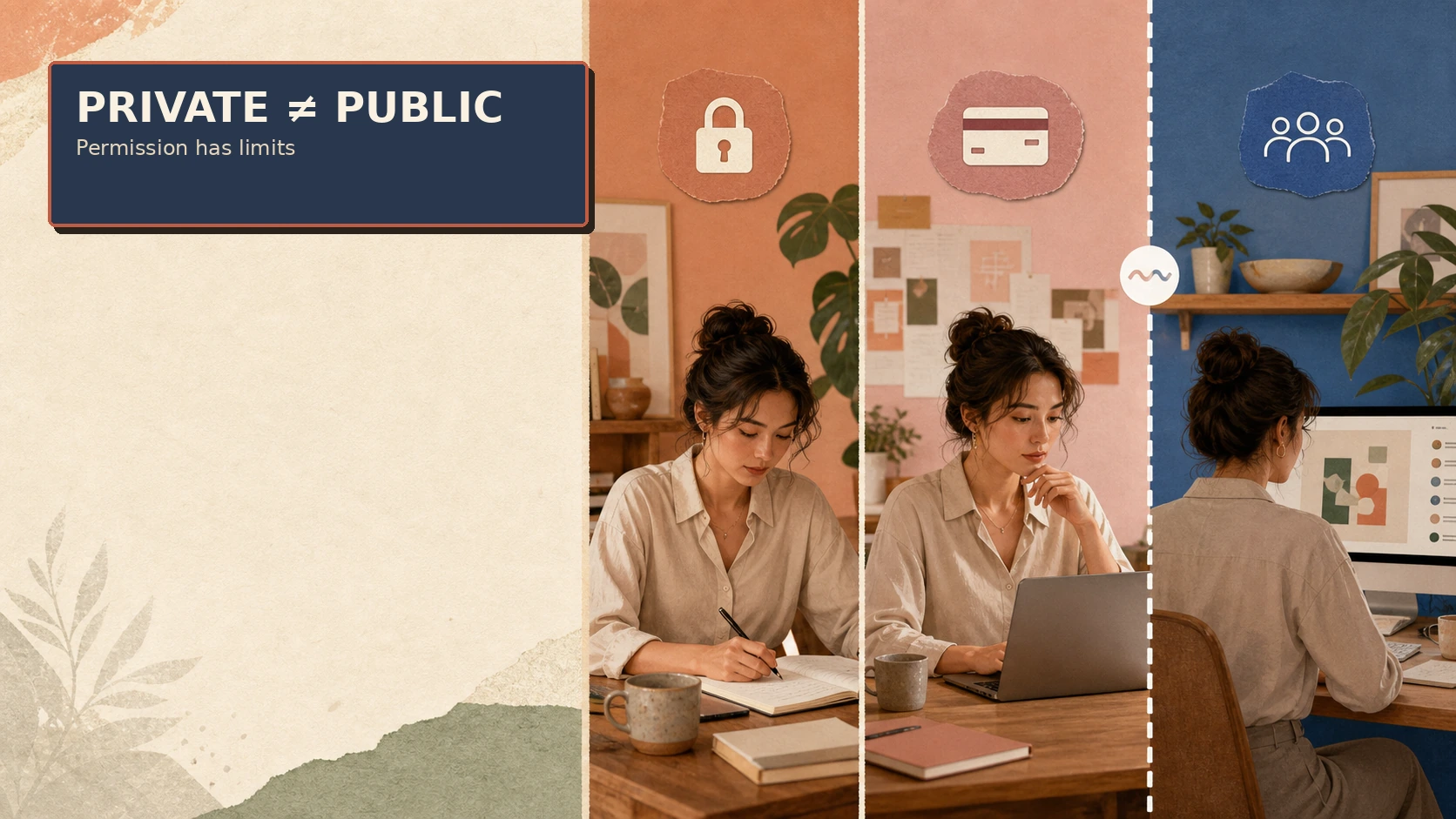
How adult creators can document permission and boundaries
- Name the people involved. Confirm who is participating and who is allowed to publish or access the work.
- Define the use. Write down whether the permission covers creation, live display, recording, editing, reposting or promotion.
- Define the audience. Separate private recipients, paying members, public visitors and commercial partners.
- Define the duration. Note whether permission is one-time, time-limited, ongoing or subject to review.
- Keep records securely. Store agreements, invoices and platform messages away from public folders.
- Review collaborator access. Remove old logins, shared drives and publishing permissions when a project ends.
Do not collect more identity information than the project requires. Sensitive consent records should be protected like any other personal data. The site’s privacy data guide explains why account, device and session information can create risks beyond the visible content itself.
Consent can change after publication
People can change their minds about future use, audience or collaboration. A withdrawal request may not erase every legal obligation or every copy instantly, but it should be treated as a serious boundary and reviewed promptly.
Creators and collaborators should agree in advance how changes will be handled. A practical process might include pausing promotion, removing future posts, restricting access, contacting platforms and checking whether third-party licences or contracts apply.
Viewers should not argue that a creator “already shared it” as a reason to ignore a new boundary. If you are unsure whether a repost remains authorised, do not repost it while you seek clarification.
Creator rights: copyright is only one part of the picture
Copyright may protect original photographs, videos, writing, artwork and other creative works. The U.S. Copyright Office explains that copyright owners can hold exclusive rights to reproduce, distribute, display, perform or authorise uses of their work, subject to legal limitations.
Read the official Copyright Office explanation for a general overview. Copyright ownership can depend on who created the work, employment arrangements, contracts and jurisdiction. It does not automatically answer every privacy, consent or publicity question.
A person may have privacy interests in how they are depicted even when another person owns the camera or copyright. Conversely, a creator may own copyright but still need to consider the consent and privacy of other participants. When the situation is complex, use a qualified lawyer rather than making a broad legal claim.
Licences make sharing rules clearer
A licence can give another person permission to use a work under defined conditions. It may cover a particular platform, a time period, attribution, payment, editing, commercial use or a requirement not to create derivatives.
WIPO’s information on copyright in the digital environment explains that existing rights continue to matter when creative works move through online networks. A licence should be read as a set of permissions and limits, not as a general invitation to do anything with the file.
Creative Commons licences are another example of structured permission. They can require attribution, restrict commercial use, limit derivatives or require ShareAlike terms. The Creative Commons licence deed explains that the exact conditions matter and that other rights, including privacy or publicity rights, may still apply.
What responsible viewers and collaborators should do
- Read the creator’s stated sharing rules before saving or reposting.
- Ask before recording a live session, even if a platform makes recording technically easy.
- Keep private material private and avoid forwarding it to friends or groups.
- Credit the creator when a licence requires attribution, but do not treat credit as a substitute for permission.
- Do not remove watermarks, crop out context or edit a work to suggest a new meaning.
- Do not use a creator’s face, voice or work to advertise a product without a clear agreement.
- Report unauthorised reposts through the platform’s privacy, copyright or abuse route.
If a creator says that something was shared without permission, do not ask them to send another copy as proof. Record the URL and report details instead. The intimate-image removal guide covers a separate response pathway when private imagery has already been distributed without consent.
How platforms can support creator control
Platforms can make consent easier to respect by offering clear audience settings, recording indicators, download controls, report categories, licence fields and fast privacy contacts. They should explain what happens to reports and avoid forcing a creator to repeatedly upload sensitive material to prove a violation.
Patreon’s Community Guidelines illustrate how a platform can require creators to document consent from real adult participants. Platform terms should also explain whether content may be reviewed, stored, licensed or used for product improvement.
The OmegleLeaked Terms of Service and Privacy Policy are examples of site-level documents to review, but they do not replace the terms of the service where content was originally created or published. Before trusting a new platform with a collaboration, use the platform reputation guide to review its privacy and reporting signals.
What to do when content is reposted without permission
Keep a private record of the URL, account, date, platform and report number. Use the original platform’s privacy, copyright or nonconsensual-sharing process. If you own the relevant rights, a copyright request may be one option; if the issue is privacy or consent, describe that clearly rather than relying on a copyright label alone.
Do not pay a stranger who promises secret removal, do not send more private files and do not publicly quote the repost. Ask a trusted person or professional to help with repetitive reports. Laws and procedures vary, especially across countries.
Common mistakes around adult creator rights
- Assuming a subscription equals ownership of every file or permission to repost.
- Confusing permission to view with permission to record or distribute.
- Using a creator’s name or image in advertising without a separate agreement.
- Believing that credit alone makes an unauthorised repost acceptable.
- Ignoring a withdrawal request because the content was once public.
- Sending private evidence through an unsecured public form.
- Using a DMCA claim when the real issue is consent or privacy, or vice versa.
FAQ: adult content online, consent and creator rights
Does paying for access let me repost the content?
Usually not. Payment may provide access under a platform’s membership terms, but it does not automatically grant reproduction, distribution, commercial or public-sharing rights.
Does a public post mean anyone can download and reuse it?
No. Public visibility does not erase copyright, privacy, publicity or platform rules. Check the creator’s licence and ask for permission when the use is not clearly authorised.
Can consent be withdrawn?
People can change their boundaries and ask that future use stop. The legal effect depends on the agreement and local law, but a withdrawal request should be handled seriously and promptly.
Is credit enough when sharing a creator’s work?
Credit is helpful when required, but it is not always a substitute for permission. A licence may impose additional conditions, and privacy or publicity rights can still apply.
What should I do if I receive a private file that was clearly not meant for me?
Do not forward, download or repost it. Tell the sender you will not distribute it, delete it when appropriate and report the source if it is being shared without consent.