How to Verify Age on Chat Sites: What Actually Works in 2026
Every video chat platform claims to verify user age. But what does that actually mean in practice? Research reveals a significant gap between platform promises and reality, making it essential to understand what age verification methods actually do—and what data they collect in the process.
The Age Verification Reality Check
Recent research from Georgia Institute of Technology and UC Irvine examined age verification systems used by major platforms and found a troubling pattern: most websites requiring age verification don’t actually enforce the policy. When sites do comply, they often rely on third-party services that collect significantly more data than necessary for age confirmation.
The study examined Yoti, a company providing age verification for approximately 60% of websites with age-gating requirements, including platforms operated by Meta, OnlyFans, Sony PlayStation, and TikTok. Researchers discovered that the verification process transmits facial images, IP addresses, and device fingerprints to third parties—including credit card companies, IP geolocation services, and data brokers.
This research demonstrates that understanding age verification methods isn’t just academic—it’s essential for protecting your personal information when using video chat platforms.
How Platforms Actually Verify Age
Self-Declaration (Honor System)
The simplest approach requires users to enter their birth date or click a checkbox confirming they meet age requirements. Platforms using this method include Facebook, YouTube, Instagram, TikTok, and Snapchat according to academic research on verification effectiveness.
The major limitation: self-declaration provides virtually no actual assurance. Research consistently finds that determined minors easily bypass honor system verification using false information or simply refreshing pages to reset failed checks. Regulators including Ofcom explicitly identify self-declaration as incapable of providing effective age assurance.
Credit Card Verification
Some platforms verify age by requiring credit card information, assuming that card issuers already screen for adult accounts. This method offers moderate friction reduction and better assurance than self-declaration, but has notable privacy implications.
According to academic research on age verification methods, credit card verification data can be transmitted to payment processors, creating records linking your payment method to the specific platform and content you accessed. For privacy-conscious users, this represents significant metadata exposure even when the card itself isn’t charged.
ID Upload Systems
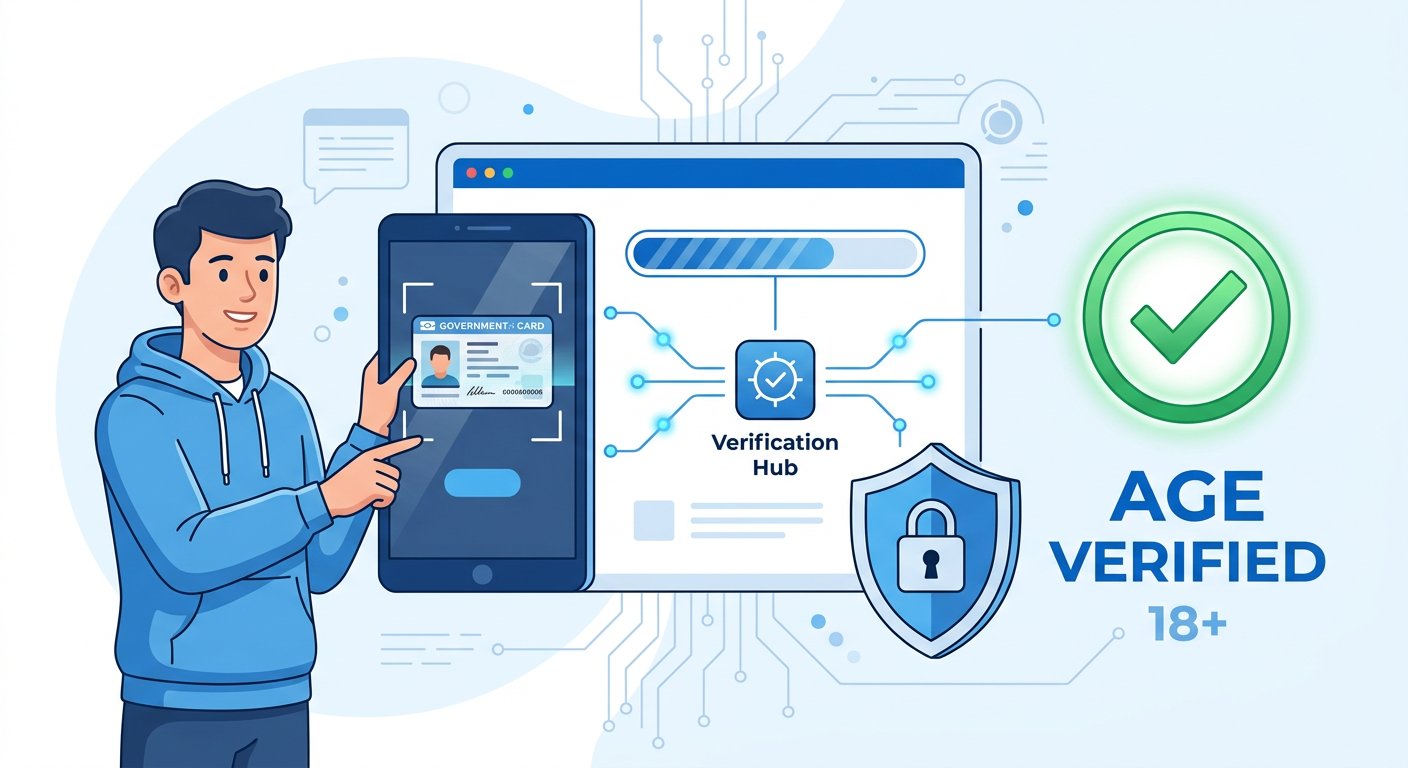
Direct identification verification requires uploading government-issued identification documents. While this method provides the highest assurance of actual age, it comes with substantial privacy concerns.
When you upload a driver’s license or passport, you expose personal data well beyond just age—name, address, ID number, and facial image become accessible to the verification system. Research notes that these systems often transmit this sensitive data to multiple parties including credit card companies and data brokers.
Even when vendors claim minimal data retention, uploaded document images may pass through multiple processing pipelines before the relevant age information is extracted and the original discarded.
AI-Based Age Estimation
Facial age estimation offers a lower-friction alternative to ID-based checks, analyzing facial features to estimate user age without requiring document uploads. However, research demonstrates significant accuracy limitations.
Age inference accuracy is strongly influenced by algorithm quality, facial characteristics, image quality, and demographic factors. Variations in lighting, camera angle, facial expression, and natural appearance differences can result in false rejections of legitimate adults or false acceptances of older-looking minors.
Additionally, even when vendors claim minimal retention, facial age estimation processes biometric data treated as highly sensitive across most regulatory frameworks.
Privacy Concerns You Should Understand
The analysis of age verification systems reveals that current implementations often collect significantly more information than necessary for age confirmation. Researchers examining major providers found that systems designed to verify only age actually broadcast personal information to multiple third and fourth-party companies.
Key privacy concerns include:
Data sharing beyond age confirmation. Facial images, device fingerprints, and IP addresses frequently transmit to entities beyond the immediate verification provider, creating comprehensive user profiles across multiple platforms.
Lack of transparency. Users rarely receive clear explanations of what data is collected, how long it’s retained, or which third parties receive access. This opacity makes informed consent impossible.
No guaranteed deletion. Even when platforms claim minimal retention, there’s often no mechanism to verify whether biometric data or facial images are actually deleted after age confirmation completes.
Vendor inconsistency. Age verification providers operate with varying privacy standards, and platform operators may not fully understand what data their chosen vendor actually collects and shares.
Which Methods Provide Best Protection?
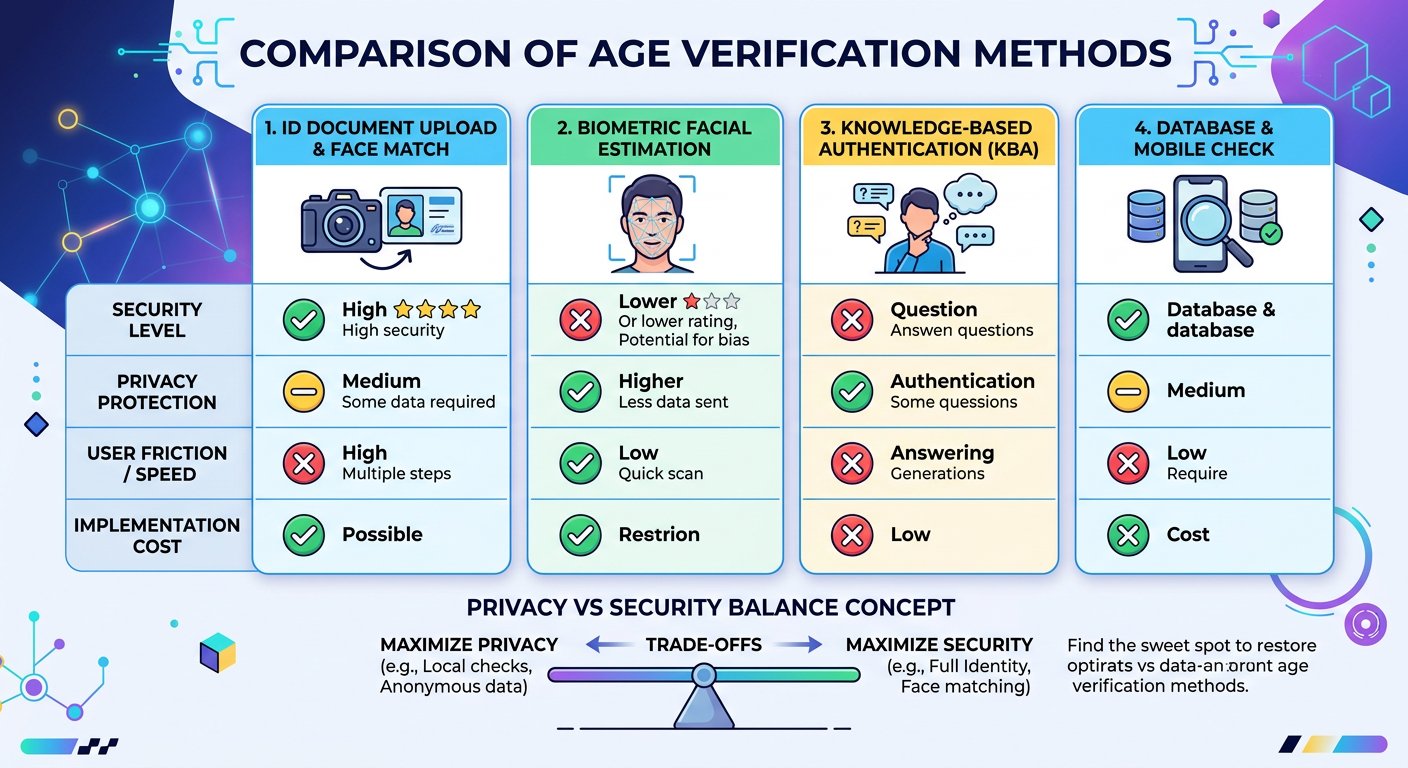
Current age verification analysis indicates that method selection involves a fundamental trade-off triangle: safety efficacy, privacy intrusiveness, and user friction. No single approach delivers optimal results across all three dimensions.
For platforms seeking to balance privacy with effective age assurance, attribute-based verification emerges as the most privacy-preserving and cybersecurity-conscious option. This approach confirms age attributes without requiring document uploads or biometric processing.
Emerging approaches using cryptographic techniques like zero-knowledge proofs offer promising alternatives. These methods allow users to authenticate age without disclosing identity, creating double-blind systems where only age confirmation passes between parties.
Until these privacy-preserving technologies achieve widespread adoption, users should understand that any age verification system involves some data collection and sharing—making it essential to evaluate platforms based on their specific implementation practices.

Frequently Asked Questions
Does age verification on video chat platforms actually work?
Research indicates most platforms don’t effectively enforce age requirements. Studies examining major social media and video platforms found that self-declaration systems provide virtually no actual assurance, with determined minors easily bypassing checks. When platforms do implement stronger verification, they often rely on third-party services that collect sensitive data beyond what’s strictly necessary for age confirmation.
What data do age verification systems collect?
Data collection varies significantly by method. Self-declaration captures only birth date claims. Credit card verification creates transaction records linking payment methods to platform access. ID upload systems expose name, address, ID numbers, and facial images. AI-based estimation processes facial biometric data. All methods may collect IP addresses, device fingerprints, and usage metadata that create comprehensive user profiles.
Is facial age estimation more private than ID upload?
Facial age estimation avoids uploading identity documents, but processes biometric data that regulatory frameworks widely treat as highly sensitive. Research shows that even when vendors claim minimal retention, facial analysis involves processing images through multiple systems where data handling becomes unclear. Neither approach eliminates privacy concerns—both just move them to different data types.
Can age verification be completely privacy-preserving?
Cryptographic approaches like zero-knowledge proofs offer the most promising path toward privacy-preserving age verification. These methods allow users to prove they’re over a specific age threshold without revealing identity or personal information beyond that binary confirmation. However, these technologies haven’t achieved widespread platform adoption, meaning current implementations sacrifice privacy for convenience.
What should I consider before submitting to age verification?
Evaluate whether the platform explains what data is collected and why. Understand which third parties receive your information. Consider whether the verification method is proportionate to the content you’re accessing. Look for platforms offering clear data retention policies and user control over their information. When in doubt, assume your data will be shared and make access decisions accordingly.
For more on protecting your privacy while using video chat platforms, explore our platform evaluation guide and learn about understanding data collection practices on these services. You can also read about how to verify age verification effectiveness before trusting any platform.